In wealth management, technical expertise may open the door — but it’s emotional intelligence (EQ) that keeps relationships intact when markets shake and clients panic. The ability to read emotional dynamics, regulate one’s own reactions, and guide others through uncertainty isn’t “soft.” It’s strategic.
Wealth managers aren’t just portfolio architects — they’re emotional interpreters. When clients face fear, loss, or confusion, it’s the advisor’s emotional intelligence that determines whether the conversation leads to clarity or catastrophe.
EQ in the Eye of the Storm
Consider the emotional weight of market crashes:
• Black Monday (1987): The Dow dropped a staggering 22.6% in one day
• Dot-Com Bubble (2000–2002): The Nasdaq fell nearly 78% from peak to trough
• The Great Financial Crisis (GFC, 2008): The S&P 500 bottomed was down 57% from its 2007 high
• COVID Crash (March 2020): The Dow plunged 12.9% in a single day
In each case, the real financial damage wasn’t the drop — it was the sell-off. Clients who liquidated 401(k)s or retirement accounts locked in losses that long-term holders eventually recovered. As Warren Buffett reportedly said during the GFC:
“I didn’t lose anything. I didn’t sell it.”
Research consistently shows that holding through downturns leads to better outcomes. A J.P. Morgan study Guide to the Markets found that missing just the 10 best days in the market over 20 years cut returns by more than half. And in a now-famous anecdote, Fidelity reportedly discovered that their best-performing accounts belonged to investors who were either dead or inactive — because they didn’t react emotionally.
This case study in behavioral finance demonstrates that one of the biggest threats to portfolio performance isn’t market volatility — it’s human behavior. And wealth managers are on the front lines as crisis counselors
Emotional Intelligence: A Key to Behavioral Coaching for Wealth Managers
Emotional intelligence isn’t a bonus skill — it’s the behavioral infrastructure that supports every client conversation, team interaction, and leadership moment. In addition to wealth managers being financial strategists, they’re also behavioral coaches. Their ability to regulate emotion, read interpersonal dynamics, and guide clients through uncertainty is what protects portfolios from panic.
At the 2018 Investments & Wealth Institute Annual Conference (ACE Nashville), Daniel Goleman, author of Emotional Intelligence: Why It Can Matter More Than IQ, emphasized that success in financial advising requires more than technical knowledge:
“While technical competencies are important, if your clients don’t trust you, then you can’t advise them.”
Goleman shared findings from his research on competence modeling, a method that compares star performers with average ones across industries. The data revealed that IQ and technical skill — the so-called “threshold competencies” — were nearly identical between both groups. What differentiated the top performers was emotional intelligence: empathy, self-awareness, adaptability, and interpersonal skill.
Though Goleman noted that direct data on financial advising is still emerging, he suggested it’s logical the same pattern applies. In wealth management, where trust and emotional clarity drive client decisions, EQ isn’t optional — it’s essential
The Bar-On Emotional Quotient Inventory: EQ as a Measurable Skillset
While there are many ways to coach EQ that can be helpful for wealth managers, the best-in-class approach is the Bar-On Emotional Quotient Inventory. It offers a rigorous framework for assessing and developing emotional intelligence — organized into five core domains, shown below.
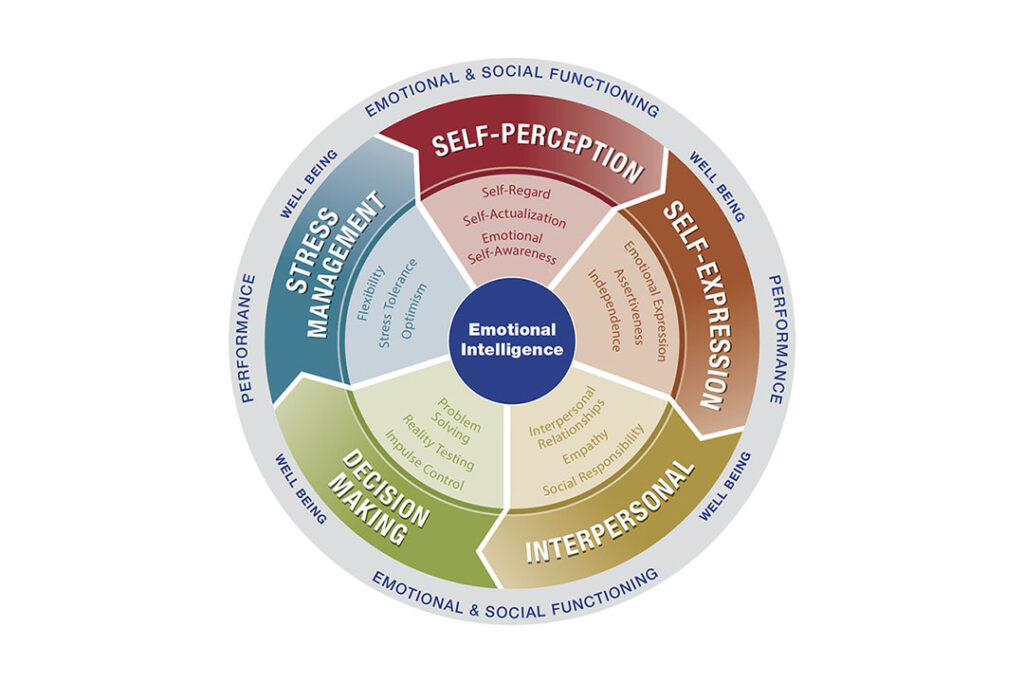
For wealth managers, this framework translates directly into client-facing performance. It helps them:
• Stay composed when clients panic
• Recognize emotional cues before they escalate
• Communicate with empathy and authority
• Guide clients toward long-term thinking
• Build trust that survives volatility
The Bar-On Emotional Quotient Inventory is also highly actionable through two coaching tools: the EQ-i 2.0 and EQ-i 360. The EQ-i 2.0 provides a robust self-assessment, helping wealth managers identify their emotional strengths and blind spots. The EQ-i 360 expands this view by incorporating feedback from others — including leaders, peers, direct reports, and potentially even clients — to reveal how one’s emotional intelligence is perceived in real-world interactions.
These tools offer a measurable way to establish benchmarks, uncover coaching opportunities, and guide ongoing development. For wealth management teams, they can be used to align behavioral dynamics, improve communication, and strengthen emotional resilience across the firm.
Strategic Takeaways
• Emotional intelligence is a hard asset in wealth management — trainable, measurable, and essential
• Market crashes test emotional fortitude more than financial acumen
• The Bar-On Emotional Quotient Inventory provides a structured way to coach EQ in financial professionals
• Wealth managers with high EQ protect client portfolios by protecting client behavior
Explore the Edge
At Transcendent Consulting, Dr. Dan helps wealth managers build emotional intelligence systems that protect client relationships and elevate performance.
If your team is ready to turn EQ into a measurable advantage, let’s talk.