Category: Featured Articles

  • Why Fund Managers Need Performance Psychology, Not Pep Talks

    Why Fund Managers Need Performance Psychology, Not Pep Talks

    In the world of fund management, billions can hinge on a single decision. The pressure is relentless — market volatility, performance demands, and internal scrutiny create a psychological strain that few professions encounter.

    Peter Lynch, one of the most successful fund managers in history, famously said:
    “Everyone has the brain power to make money in stocks. Not everyone has the stomach.”
    It’s a powerful reminder that while analytical skills are essential, emotional regulation is what amplifies performance and creates staying power. To excel in fund management, you need both: critical thinking skills and emotional regulation skills.

    The Pep Talk Problem

    When fund managers seek psychological support, they’re often met with motivational coaching. While well-intentioned, these approaches rarely offer the structured, evidence-based tools needed to perform under pressure.

    Take Tony Robbins, for example — a coach and thought leader often associated with motivation, but whose work goes far deeper.

    In his TED Talk Why We Do What We Do, Robbins clarifies:

    “I’m not here to motivate you, you don’t need that obviously. Often that’s what people think I do, and it’s the furthest thing from it…I’m the ‘why’ guy. I want to know why you do what you do. What is your motive for action?…Because, I believe that the invisible force of internal drive, activated, is the most important thing in the world. I’m here because I believe emotion is the force of life.”

    Robbins’ work within the financial sector is far-reaching. He has coached some of the world’s top investors, including Paul Tudor Jones, who credits Robbins with helping him regain success in the markets. Robbins has authored books like Money: Master the Game and Unshakeable: Your Financial Freedom Playbook.

    Robbins asserts that success is 80% psychology and 20% strategy. That ratio speaks volumes. It’s not about hype — it’s about harnessing the invisible forces that drive behavior. And that’s where performance psychology enters the picture.

    What Performance Psychology Actually Offers

    Performance psychology is born out of elite sport and is built on protocols — not platitudes. It’s designed to optimize execution under stress and strengthen mindset through repeatable strategies.

    The premise that mental fortitude is a key contributor to successful performance is supported throughout history. Baseball Hall of Famer Willie Mays once said:

    “What you are thinking, what shape your mind is in, is what makes the biggest difference of all.”
    This insight speaks directly to the heart of performance psychology. It’s not just about talent or tactics — mental state plays a key role in governing execution. In fund management, where precision and timing are everything, mindset isn’t a nice-to-have — it’s a must-have. Put simply, it’s a performance multiplier.

    Performance psychology equips fund managers with mental tools that sharpen focus, enhance resilience, and improve decision-making under pressure. While its applications are broad, here are three high-impact domains where it consistently delivers results:

    Emotional Regulation Under Pressure

    Fund managers operate in environments of constant ambiguity and scrutiny. Performance psychology trains emotional regulation — the ability to stay composed, adaptive, and focused. Techniques like breathwork, cognitive reframing, and recovery routines help maintain clarity and prevent reactive decisions.

    Decision-Making Protocols

    In volatile markets, instinct alone isn’t enough. Performance psychology introduces structured decision frameworks, attentional cues, and pre-performance routines that reduce bias and improve consistency.

    Recovery and Reset Strategies

    Mental fatigue is inevitable. Just as athletes use recovery protocols to maintain peak performance, fund managers benefit from cognitive reset strategies — from micro-breaks to mindfulness exercises — to sustain focus across long cycles.

    Fund Managers as Strategic Performers

    Fund managers aren’t just analysts — they’re strategic performers navigating high-stakes environments where precision, timing, and psychological control matter. Like elite athletes, they must execute under pressure, adapt quickly, and recover efficiently.
    Performance psychology equips them with the tools to do exactly that.

    Strategic Takeaways

    • Performance psychology is not a luxury — it’s a competitive edge.
    • Fund managers need systems, not slogans.
    • Emotional regulation is a key contributor to alpha.

    Explore the Edge

    At Transcendent Consulting, Dr. Dan helps fund managers build psychological precision through evidence-based protocols drawn from elite sport and organizational science.
    If you’re ready to move beyond inconsistent performance and into mastery, let’s talk.

  • The Recovery Protocol: How Fund Managers Sustain Peak Performance

    The Recovery Protocol: How Fund Managers Sustain Peak Performance

    Fund Managers sometimes treat recovery as a reward — a well-earned pause after the pressure subsides. It’s understandable. In finance, the pace is relentless and the stakes are high. But this mindset can lead to the same mistake seen in high-performance domains like elite sport, where athletes push to the point of burnout or fall into traps like “embrace the grind” or “earn your rest.” The truth is, whether you’re a professional athlete or a professional investor, the principles of sustainable performance are the same. You must give yourself consistent breaks — even if they’re brief. A short, deliberate routine can have dramatic effects on your physiology and decision-making.


    In the fields of elite performance — the individuals who operate at the highest level have learned a critical truth: recovery isn’t a reward. It’s an essential protocol. These performers understand that mental reset is what protects precision, timing, and emotional control — especially when the margin for error is razor-thin. Fund managers operate in similar conditions. And without structured recovery, even the most resilient performers risk cognitive erosion.


    As Dr. Anders Ericsson, Professor Emeritus and a leading authority on human performance, once observed:
    “Elite performers rarely push themselves for more than 4–5 hours of peak mental effort daily without interspersed breaks.”
    Ericsson studied expertise across the fields of medicine, music, chess, and sport. The principles he uncovered are just as applicable to trading and fund management. The ability to reset — not just endure — is what sustains elite performance

    Trading Is a High-Pressure Environment — And the Data Proves It

    Stress isn’t just a subjective experience — it’s rooted in physiology. The pressure fund managers face has real physiological implications. Coates and Herbert at the University of Cambridge studied traders in the City of London and found that during an 8-day period of heightened market volatility, traders experienced a 68% increase in cortisol levels daily. Cortisol is the body’s primary stress hormone — and elevated levels over time impair decision-making, increase emotional reactivity, and erode long-term health.

    Recovery Is a Protocol, Not a Perk

    Elite performers don’t wait until burnout to recover. They build reset protocols into their daily rhythm. These micro-interventions are designed to restore clarity and control.


    As Dr. Jim Loehr, renowned performance psychologist and co-founder of the Human Performance Institute, explains:
    “Recovery is not a luxury—it is a necessity. The key to peak performance is the rhythmic oscillation between energy expenditure and energy renewal.”


    In his Harvard Business Review article co-authored with Tony Schwartz, Loehr describes how elite tennis athletes use short recovery rituals between points to dramatically improve performance:
    “We first understood the power of rituals to prompt recovery by observing world-class tennis players in the crucible of match play… The competitors with the most consistent rituals showed dramatic oscillation, their heart rates rising rapidly during play and then dropping as much as 15% to 20% between points.”


    This challenges a pervasive belief in finance — the myth that nonstop effort equals the best outcomes. The most successful athletes and performers have learned that they must train hard and recover deliberately. Whether through long-term recovery plans like sleep, diet, exercise, and work-life integration, or through the moment-to-moment resets, they’ve learned to recover in real time.


    As LeBron James has said:
    “Recovery is just as important as the training itself. You have to listen to your body.”
    Fund managers are cognitive athletes. Their edge depends on clarity, timing, and emotional control. Without recovery, those systems degrade. And when they do, performance becomes reactive, not intentional.

    Mental Reset Tools for Fund Managers

    Many research-linked and evidence-based protocols from sport and performance psychology can be adapted for fund managers. These techniques have dramatic effects on physiological, mental, and neurological systems — lowering stress hormones like cortisol, diminishing cognitive load, and improving clarity under pressure.

    To name a few: 

    • Mindfulness exercises cultivate present-moment awareness, allowing individuals to observe thoughts and emotions with greater objectivity. 

    • Breathwork involves intentional control of breathing patterns to influence physiological and emotional states. 

    • Cognitive breaks are brief, deliberate pauses from analytical thinking that reset attention and restore mental clarity.

     • Recovery routines are short, intentional practices interspersed throughout the day that help regain composure, restore focus, and sustain performance under pressure.

    In the past, there was sometimes skepticism — and at extreme levels, even stigmatization — around these types of practices. But that has largely evolved. High performers looking for an edge have come to appreciate both the personal well-being benefits and the positive performance enhancement these tools offer.

    Strategic Takeaways

    • Recovery isn’t a break from performance — it’s part of it 

    • Mental reset protocols protect clarity, timing, and emotional control 

    • Fund managers who ignore recovery are trading short-term effort — and potentially short-term gains — for long-term cognitive erosion and profit erosion

    Explore the Edge

    At Transcendent Consulting, Dr. Dan helps fund managers build mental reset systems that protect clarity and extend performance.

    If your team is ready to stop leaking cognitive capital, let’s talk.

  • The Myth of Soft Skills: Why Emotional Intelligence Is a Hard Asset in Wealth Management

    The Myth of Soft Skills: Why Emotional Intelligence Is a Hard Asset in Wealth Management

    In wealth management, technical expertise may open the door — but it’s emotional intelligence (EQ) that keeps relationships intact when markets shake and clients panic. The ability to read emotional dynamics, regulate one’s own reactions, and guide others through uncertainty isn’t “soft.” It’s strategic.

    Wealth managers aren’t just portfolio architects — they’re emotional interpreters. When clients face fear, loss, or confusion, it’s the advisor’s emotional intelligence that determines whether the conversation leads to clarity or catastrophe.

    EQ in the Eye of the Storm

    Consider the emotional weight of market crashes:

    • Black Monday (1987): The Dow dropped a staggering 22.6% in one day
    • Dot-Com Bubble (2000–2002): The Nasdaq fell nearly 78% from peak to trough
    • The Great Financial Crisis (GFC, 2008): The S&P 500 bottomed was down 57% from its 2007 high
    • COVID Crash (March 2020): The Dow plunged 12.9% in a single day

    In each case, the real financial damage wasn’t the drop — it was the sell-off. Clients who liquidated 401(k)s or retirement accounts locked in losses that long-term holders eventually recovered. As Warren Buffett reportedly said during the GFC:

    “I didn’t lose anything. I didn’t sell it.”

    Research consistently shows that holding through downturns leads to better outcomes. A J.P. Morgan study Guide to the Markets found that missing just the 10 best days in the market over 20 years cut returns by more than half. And in a now-famous anecdote, Fidelity reportedly discovered that their best-performing accounts belonged to investors who were either dead or inactive — because they didn’t react emotionally.

    This case study in behavioral finance demonstrates that one of the biggest threats to portfolio performance isn’t market volatility — it’s human behavior. And wealth managers are on the front lines as crisis counselors

    Emotional Intelligence: A Key to Behavioral Coaching for Wealth Managers

    Emotional intelligence isn’t a bonus skill — it’s the behavioral infrastructure that supports every client conversation, team interaction, and leadership moment. In addition to wealth managers being financial strategists, they’re also behavioral coaches. Their ability to regulate emotion, read interpersonal dynamics, and guide clients through uncertainty is what protects portfolios from panic.

    At the 2018 Investments & Wealth Institute Annual Conference (ACE Nashville), Daniel Goleman, author of Emotional Intelligence: Why It Can Matter More Than IQ, emphasized that success in financial advising requires more than technical knowledge: 

    “While technical competencies are important, if your clients don’t trust you, then you can’t advise them.”

    Goleman shared findings from his research on competence modeling, a method that compares star performers with average ones across industries. The data revealed that IQ and technical skill — the so-called “threshold competencies” — were nearly identical between both groups. What differentiated the top performers was emotional intelligence: empathy, self-awareness, adaptability, and interpersonal skill.

    Though Goleman noted that direct data on financial advising is still emerging, he suggested it’s logical the same pattern applies. In wealth management, where trust and emotional clarity drive client decisions, EQ isn’t optional — it’s essential

    The Bar-On Emotional Quotient Inventory: EQ as a Measurable Skillset

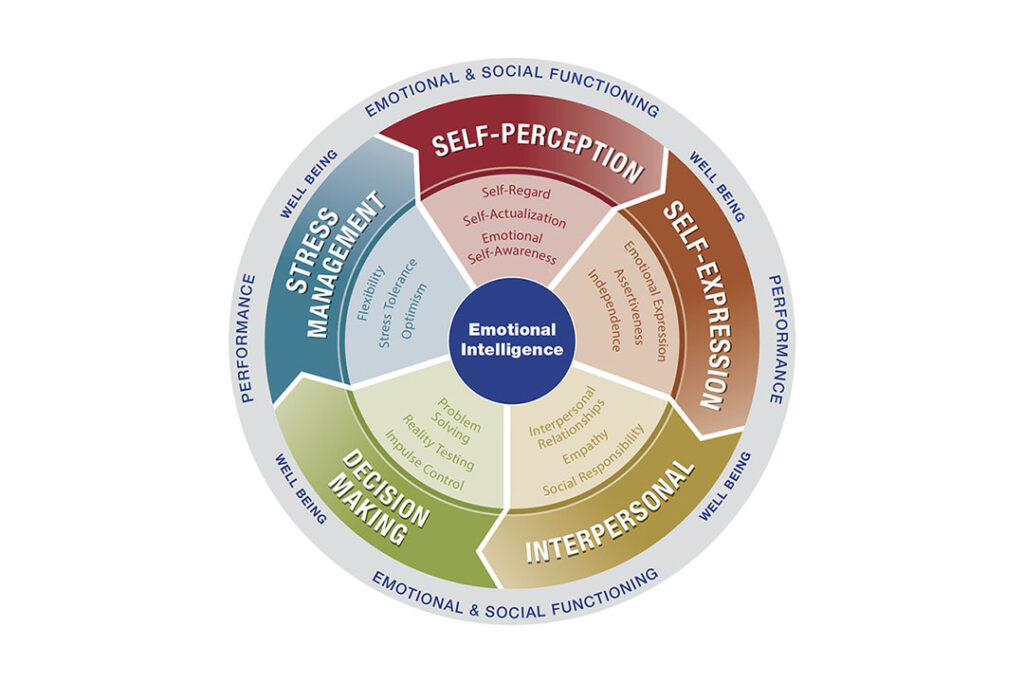
    While there are many ways to coach EQ that can be helpful for wealth managers, the best-in-class approach is the Bar-On Emotional Quotient Inventory. It offers a rigorous framework for assessing and developing emotional intelligence — organized into five core domains, shown below.

    For wealth managers, this framework translates directly into client-facing performance. It helps them:


    • Stay composed when clients panic
    • Recognize emotional cues before they escalate
    • Communicate with empathy and authority
    • Guide clients toward long-term thinking
    • Build trust that survives volatility

    The Bar-On Emotional Quotient Inventory is also highly actionable through two coaching tools: the EQ-i 2.0 and EQ-i 360. The EQ-i 2.0 provides a robust self-assessment, helping wealth managers identify their emotional strengths and blind spots. The EQ-i 360 expands this view by incorporating feedback from others — including leaders, peers, direct reports, and potentially even clients — to reveal how one’s emotional intelligence is perceived in real-world interactions.

    These tools offer a measurable way to establish benchmarks, uncover coaching opportunities, and guide ongoing development. For wealth management teams, they can be used to align behavioral dynamics, improve communication, and strengthen emotional resilience across the firm.

    Strategic Takeaways

    • Emotional intelligence is a hard asset in wealth management — trainable, measurable, and essential
    • Market crashes test emotional fortitude more than financial acumen
    • The Bar-On Emotional Quotient Inventory provides a structured way to coach EQ in financial professionals
    • Wealth managers with high EQ protect client portfolios by protecting client behavior

    Explore the Edge

    At Transcendent Consulting, Dr. Dan helps wealth managers build emotional intelligence systems that protect client relationships and elevate performance.

    If your team is ready to turn EQ into a measurable advantage, let’s talk.